
Estate planning can be overwhelming. One is more likely than not to hear the terms living will, trust, probate, etc., and blend them into one confusing jumble. The feelings of anxiety associated with the confusion is amplified for New Yorkers, experiencing the sometimes convoluted legalese and judicial processes one must deal with in the state.
If you are reading this, you likely are one of the people who want to get the maximum benefit possible from your assets. One of the useful planning documents to facilitate this is called a testamentary trust. It is not just a legal document, but a mechanism to provide for the protection of your family after you are no longer able to protect them yourself.
This guide will give you peace of mind in showing you what a testamentary trust is, how it is recognized in the legal framework of New York, and how it may be the optimal planning document to help you along with your estate plan.
What is A Testamentary Trust?
Although simple in concept, testamentary trusts involve more complexities than one would think on the surface. While living, one can put most other kinds of trusts into effect immediately should one want to, but testamentary trusts can only go into effect after the trustee dies. It is for this reason testamentary trusts are sometimes called dormant trusts, as they exist in a sense, but don’t do anything until an external event occurs. This is a passive, hands-off approach than other kinds of trusts by design.

The set of instructions within the will can be thought of as a strongbox that only materializes after the account holder dies. The account holder must appoint a trustee – a person they must trust beyond all others – to look after the valuables safeguarded by this strongbox on behalf of the account holder’s family and other loved ones, known as beneficiaries. If the beneficiaries are young and underage, it may come into effect as a trust for a minor. This is commonly seen in scenarios where the account holder is a parent who aims to leave assets for underage children but would not wish for the children’s 18-year-old self to inherit all of it at once.
Is It Set in Stone?
One question that often comes up is: Is a testamentary trust revocable? The short answer is: It depends on timing. At the end of the day, it is in your will, and so at any point in time that you are alive and have the mental capacity to do so, you can change it, adjust it, or remove it.
Subsequently, you just have to update your will. Of course, once you die, the will is no longer changeable. At that point, the trust becomes activated and is irrevocable. Whatever the conditions of the trust are, you will not have any ability to change them once you are dead, nor will your heirs.
This is the point in time where many make the mistake of thinking that they can treat the trust as if they still have ownership of it. This is what we mean when we say letters testamentary meaning, which we will cover later, but the trust is, of course, the car, and the letters are just the ignition keys.
Testamentary Trust vs Living Trust
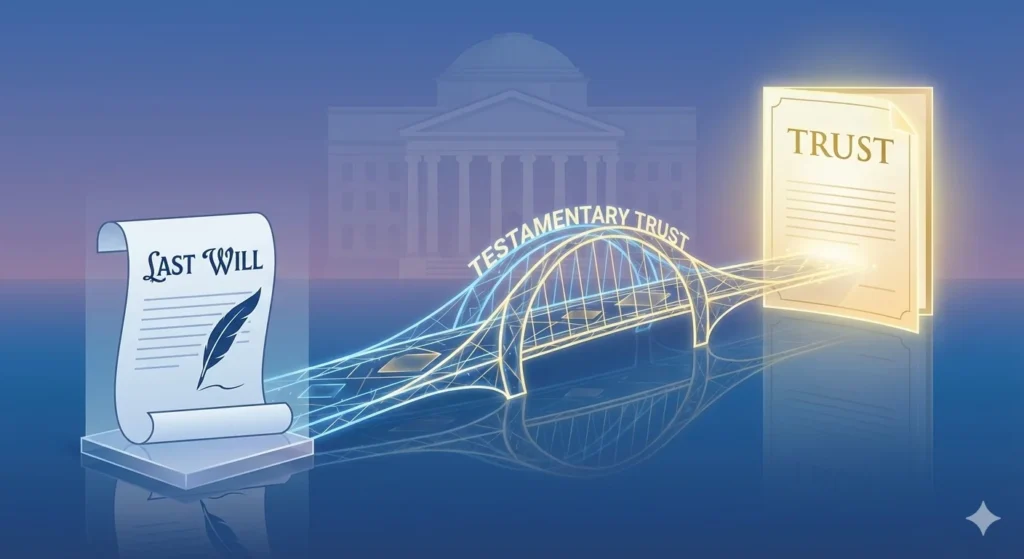
At some point while you start planning, you will have to make an important decision: testamentary trust vs living trust. They are both great options, but they are directed at different audiences and time periods.
Living Trusts (or Inter Vivos Trusts) can be established and funded while you are still alive. To do it properly you must transfer the titles of your home, bank accounts, and investment accounts into the trust (this requires some paperwork). As long as you are alive you are in control of the trust as the trustee.
How is a testamentary trust different from a living trust?
The Probate Pipeline
To activate a testamentary trust, it must go through the probate pipeline, which, in New York, is the Surrogate’s Court. It can be time-consuming, but it’s the only way to validate the will and “birth” the trust.
The Executor and Letters of Authority
To activate a testamentary trust, it must go through the probate pipeline, which, in New York, is the Surrogate’s Court. It can be time-consuming, but it’s the only way to validate the will and “birth” the trust.
The procedure starts with the Executor of your Will being the first to present the Will to the Court. The Court then reviews the Will and, provided it is in good order, the Judge will approve it. The Court then issues the Executor a Letter of Authority.
What, then, is a letter of testamentary? With a name that implies plural, it is in fact one legal document from the probate court. It is the executor’s “proof” that they can access bank accounts, transfer ownership of properties, and, most importantly, move assets into your testamentary trust. Without this letter of testamentary, your executor is powerless. They can’t even withdraw money to pay a funeral bill without it.
The terms probate letters testamentary and letters of testamentary are simply interchangeable as they refer to the same document issued by the court.
Exceptions and Alternatives
It’s worth pointing out that letters testamentary no will is a legal impossibility. If you are to, unfortunately, die without a will (intestate), the court will instead provide “Letters of Administration” and a testamentary trust cannot exist as there were no directions to establish one.
Some New Yorkers try to avoid this process by using testamentary substitutes. These are assets that are transferred to a beneficiary without going through probate. This also includes life insurance policies that have named beneficiaries, investment accounts with “Transfer on Death” designations, and jointly owned houses. These may seem to be “protected” from probate, however, they are also “protected” from the control and protection mechanisms that can be implemented through a trust.
For instance, if a minor is named as a direct beneficiary on an insurance policy, you could trigger another, potentially more complicated process that involves obtaining the guardianship of the minor from the court.
New York Nuances: What Empire State Residents Must Know
The Surrogate’s Court is organized a little differently in each of the boroughs. The thick bureaucracy in the court system requires precise terminology.
When your executor goes to court, they are not only seeking a rubber stamp of approval. They are filing a petition for letters testamentary New York State courts will accept as valid and acknowledged. These clerks are not forgiving. For instance, if a petition contains a typo, it can (and will) lead to significant delays or outright rejection.
For instance, in order to acquire a letter of testamentary New York state, one needs to obtain the original will, a death certificate, and frequently need family waivers stating they will not contest the will. If you need forms for the will, they may be in the system as a letter of testamentary New York application, as the state heavily regulates official forms.
There is also the issue of time, and how much time it takes. In some smaller, more rural counties, it may only take a couple of weeks to get a New York judge to sign a letter of testamentary. In more populated boroughs, such as Queens or Kings County (Brooklyn), there is a backlog, which means it may take New York courts months to get letters of testamentary signed.
This is why it is very important to understand the specific nuances to get letters of testamentary New York. Because there is a lag time in the processing, it is important to document all of the requirements very carefully, as even a small mistake can cause your request for letters of testamentary to drop to the back of the processing queue.
The nature of the probate process, the public nature of documents involved, the time delays that are common within the New York court system, the obligations that trustees have to their beneficiaries, and the New York Private Residents need for assistance all collate to create a heavy burden on New York Residential Probates.
Booking an initial consultation to secure the assistance of a New York City attorney for testamentary trust drafting and administrative services will help New York residents navigate planning for a legally enforceable and flexible will that would protect your beneficiaries, and satisfy the requirements of the New York Surrogate’s Court to have your will executed.
Conclusion: Is a Testamentary Trust Right for Your New York Estate Plan?
Estate planning is, most essentially, a mechanism for providing your loved one’s a new chapter, and not the end. The testamentary trust serves to keep your estate and legacy safe and secure while providing a significant level of control that basic wills lack. It ensures the estate and the inheritance are a blessing rather than a burden.
A Testamentary Trust Does the Following:
This path is not clear sailing. In New York, the probate process is lengthy and open to public scrutiny. Weighing this option against a living trust is a tactical choice considering your assets, your familial relationships, and your finances.
The New York legal system is not a place to go alone. It’s vital to have professional help, whether you are creating a will, or dealing with the probate process of a loved one. If a testamentary trust suits your objectives, consult a professional in estate planning. It’s a matter of your peace of mind and your family’s future.