

The day a divorce becomes final, most people feel one clean thing above all else. Relief. The folder closes, the last signature dries, and it is tempting to believe your affairs are finally settled. I understand that feeling completely. But I have to tell you something I tell every client who walks into my office in Forest Hills or out on Long Island after a divorce. Your decree and your estate plan are two entirely different animals, and finishing one does almost nothing to fix the other.
Your divorce decree governs the end of your marriage. Your estate plan governs what happens to your children, your money, and your wishes if something happens to you. One closed a chapter. The other is still sitting there, quietly running on instructions you wrote for a life you no longer live. Let me walk you through what actually needs to change, in plain language, the way I would across my desk.
Your plan should describe the family you have now, not the one you had

A divorce reshapes your life from the studs up, and an estate plan that predates it is often frozen in a moment that no longer exists. I see the same pattern again and again. An old will still names a former spouse as executor. A power of attorney still gives an ex the authority to manage money and sign documents. A health care proxy still lists the very person you are no longer speaking to as the one who decides your medical care.
Think about what that means in a real emergency. If you were in a hospital bed tomorrow, unable to speak for yourself, the plan you signed five years ago might hand every decision to someone you divorced. That is not a hypothetical I am inventing to frighten you. It is the default that stays in force until you change it.
The fix is not complicated, but it does have to be deliberate. A properly updated plan makes sure the people you trust today, a sibling, a grown child, a close friend, a new partner, are the ones authorized to act. It accounts for new relationships, children from a second marriage, and a financial picture that looks different now that assets have been divided. We handle all of this as part of our Wills and Trusts services in New York, and it usually takes far less time than people expect.
The New York twist on your ex and your beneficiaries
Here is where New York does something a lot of people do not realize, and where a little knowledge can be dangerous if you stop halfway.
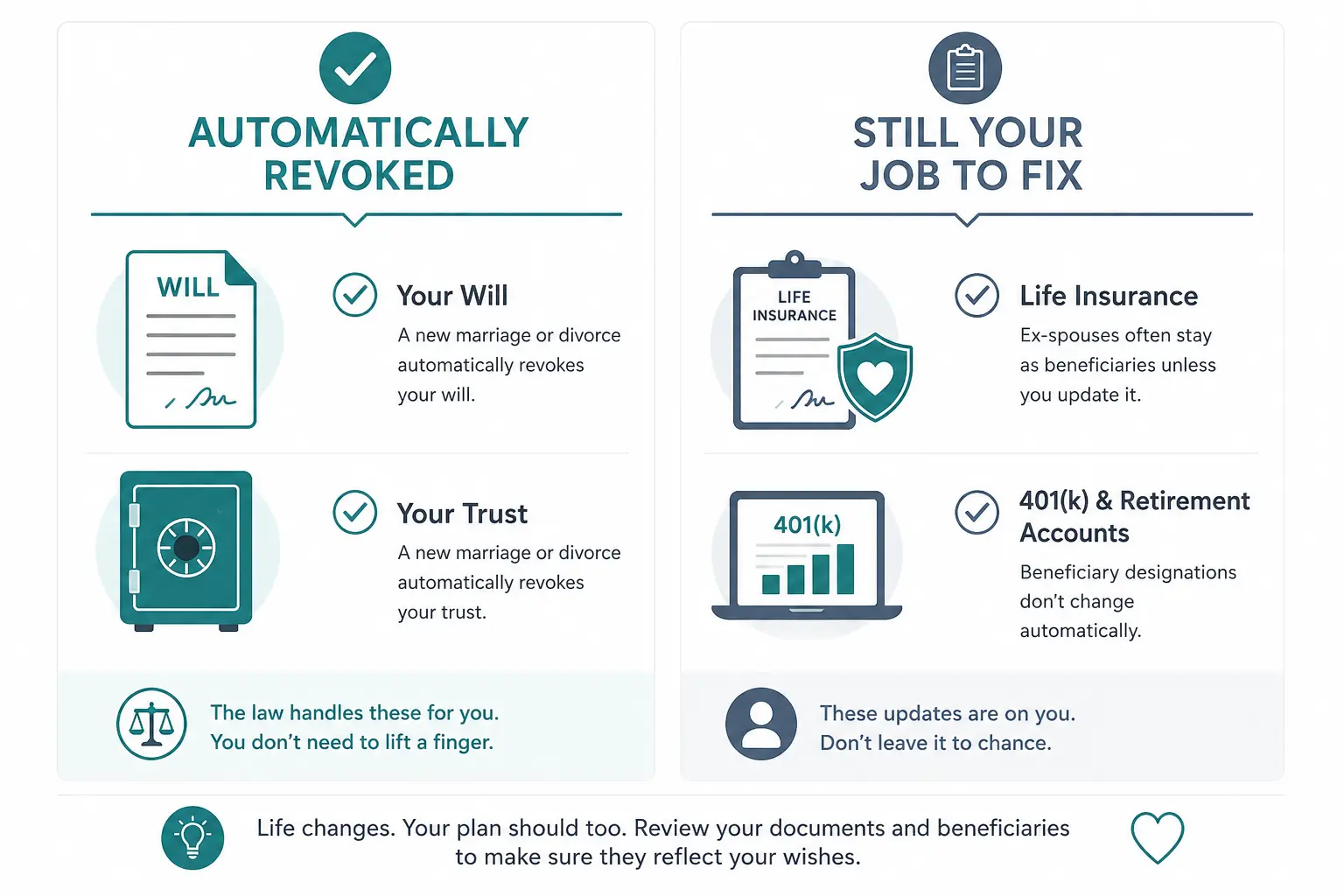
Under a state law called EPTL section 5-1.4, a final divorce automatically revokes most gifts and appointments you made to a former spouse. In the eyes of the law, once the decree is entered, your ex is treated as if they died before you. That covers your will, a revocable trust, a transfer on death designation, and, importantly, their nomination as your executor, trustee, or agent. New York, in other words, tries to clean up after you.
So can you relax? Not quite, and this is the part I never let a client gloss over. That automatic revocation has real gaps. It only kicks in after a final judgment, so during a separation, before the decree, your ex remains right where you left them on every document. It does not reach irrevocable designations. And it does not reliably reach the single largest account many people own, an employer retirement plan like a 401(k), because those plans are governed by federal law that can override the state rule. The United States Supreme Court has held as much. Which means your ex can remain the legal beneficiary of your workplace retirement account long after the marriage ends, no matter what New York law says on paper.
Life insurance policies and retirement accounts pass by contract, straight to whoever is named on the form, and that named person collects regardless of what your will or trust says. So please do not assume this was handled. Confirm it, directly, with each institution. Call the insurer. Call the plan administrator. Get it in writing. I have watched a death benefit land in the lap of a former spouse simply because a form was never updated, and there is no undo button once the check is cashed.
Protecting a minor child’s inheritance
If you have young children, this next piece deserves your full attention, because the default outcome is one almost no divorced parent actually wants.
Leave money to a minor outright, with no structure around it, and New York does not simply hand it to the child. A court appoints someone to hold and manage it, often the surviving parent. In a post divorce family, that surviving parent may be your former spouse. Picture it plainly. The assets you set aside for your children could end up managed by the person you divorced, under a judge’s supervision, on terms you never chose.
A trust solves this cleanly. You name the trustee, someone you actually trust to manage that money wisely, and you write the rules. You decide the age at which your child receives their share, whether it comes in stages, and what it can be used for along the way. This is exactly the kind of planning we walk through in our guide on how to set up a trust fund for a child in New York. It keeps the inheritance on the path you intend, not the path a default rule picks for you.
Guardianship, both the long term and the sudden

Guardianship is where I see the most heartbreak, and also the most misunderstanding, so let me separate the two questions people tend to blur together.
The long term question is who raises your children if you are gone. If one parent dies, the other generally keeps custody as a matter of law, and a will cannot override that. Where it gets contested is when both parents are unavailable. There, absent a documented preference, a court decides who raises your children. In blended families, with stepparents, grandparents, and relatives all in the picture, that decision is fought over more often than you would believe. Naming a guardian in your will does not tie a judge’s hands, but it puts your voice squarely in the room, and judges give it real weight.
Then there is the gap almost no plan addresses, and the one that worries me most. It is the stretch of time immediately after an emergency, before any court process can even begin. Say you are hospitalized suddenly. The adult standing with your children, a grandparent, a partner, a trusted friend, may have no legal standing to consent to medical care or make a fast decision on their behalf. Hours matter, and the law does not care who loves the child most. It cares who has authority.
New York gives you a quiet, underused tool for exactly this. Under the state’s Designation of Person in Parental Relation law, a parent can name another adult to make medical and school decisions for a child for up to twelve months, with no court involvement at all. It is a short document. It costs almost nothing. And it can be the difference between a caregiver who can act and one who is left standing helpless at a hospital desk. Pairing that with a proper guardian nomination closes both ends of the gap, the sudden and the long term.
What an updated plan actually looks like
Putting it together, a post divorce estate plan in New York usually means refreshing a handful of connected documents so they finally speak with one voice. A new will that names the executor and guardian you want today. A revocable trust if you have minor children or property you would rather keep out of Surrogate’s Court. A power of attorney and a health care proxy naming agents you actually trust. Updated beneficiary designations on every policy and account, confirmed institution by institution. And that short designation form so someone can care for your children in the first frightening hours of an emergency.
None of these is heavy on its own. The value is in getting them aligned, so that the plan reflects the present rather than a past you have already moved on from.
Moving the conversation forward
If you have recently gone through a divorce, or you are in the middle of one, this is the right moment to look at your plan with fresh eyes, not five years from now when a document nobody updated finally gets tested.
A divorce changes who should be in charge of your life and your children. Your documents should say so.
Frequently Asked Questions
The bottom line
We make this simple. Start by booking a Peace of Mind Planning Session. We will answer your questions, review your options, and go over our flat fees. If we are a good fit, we will talk about next steps. If not, that is fine too. Mention this blog and we will accord a discount toward our Estate Plans.
You can also see how we work over at bartallaw.com or reach us through our contact page, and we will take it from there.